If you want to know how to start a cloud kitchen in India, you are looking at one of the most promising food business opportunities available today. No dine-in space. No expensive interiors. No large front-of-house staff. Just a well-equipped kitchen, a great menu, and access to millions of hungry customers through Zomato and Swiggy.
India’s cloud kitchen market is projected to cross Rs 4,000 crore by the end of 2026, growing at 25 to 28% CAGR, and is estimated to reach USD 2.92 billion in 2026 alone. Entrepreneurs across the country are entering this market every month, drawn by lower startup requirements compared to traditional restaurants and a delivery infrastructure that is already built and waiting.
But knowing where to start is the challenge. This guide covers every step you need to take, from choosing your concept and location to setting up your equipment, getting your licences, and going live on delivery platforms. Where a topic goes deeper, we link to our dedicated guide so you can read as much detail as you need
1. What Is a Cloud Kitchen?
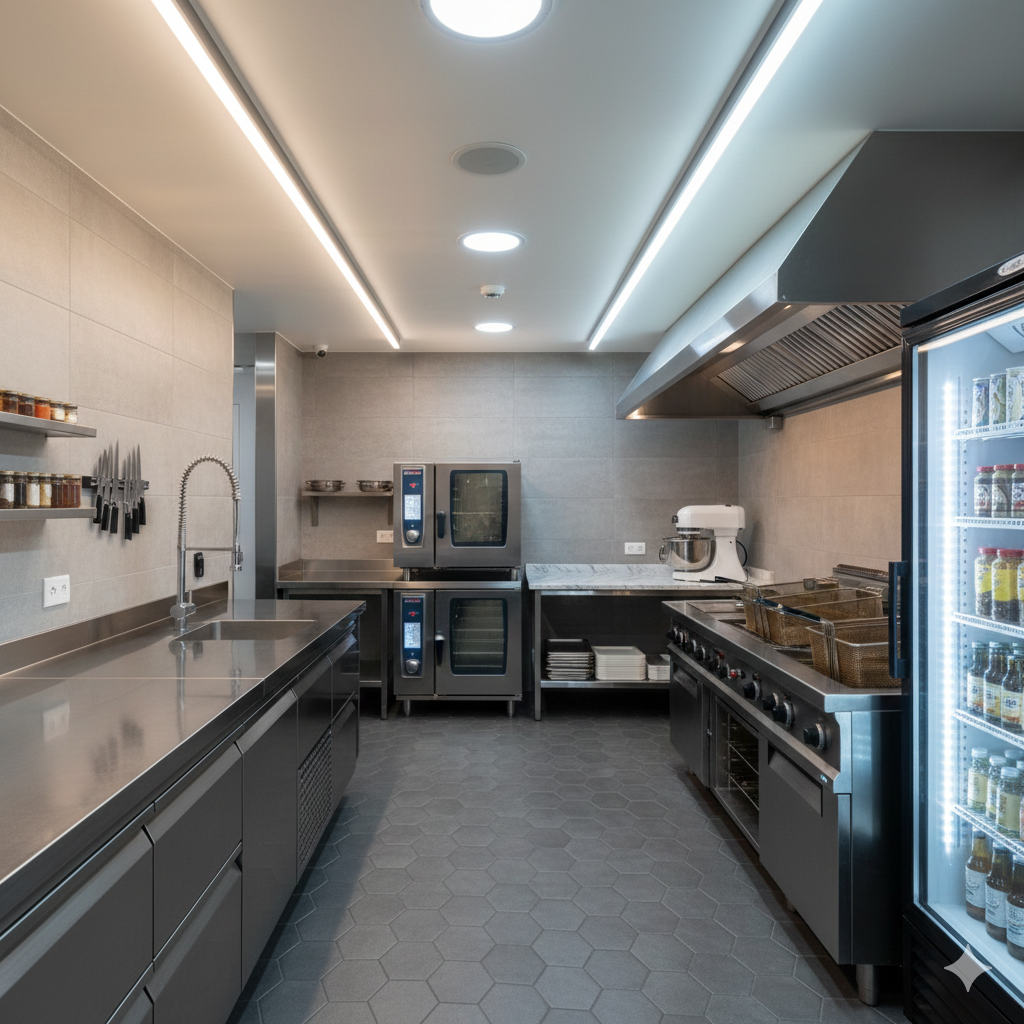
A cloud kitchen, also called a ghost kitchen or virtual kitchen, is a delivery-only food business that operates without a dine-in space. Orders arrive through food delivery platforms like Zomato, Swiggy, or directly through your own website or app. Food is prepared in a commercial kitchen and dispatched via delivery partners. There is no dining room, no waitstaff, and no walk-in customers.
The model strips the food business down to its two core elements: food preparation and delivery. This reduction in complexity is exactly what makes cloud kitchens attractive to entrepreneurs, experienced restaurateurs looking to expand, and home chefs making the transition to commercial operations.
Cloud kitchens offer operational efficiencies through centralised production, reduced overhead costs compared to traditional restaurants, and the ability to cater to multiple brands or cuisines from a single location.
2. Why Start a Cloud Kitchen in India Right Now?
The market conditions for cloud kitchens in India have never been better aligned. Several factors are driving growth simultaneously:
Growing food delivery demand India’s cloud kitchen market is expanding at a 25 to 28% CAGR in 2026, with the market projected to reach Rs 4,000 crore by the end of this year and Rs 6,500 crore by 2028. Online food delivery now accounts for a growing share of the country’s total food service industry, and that share is increasing every year. More consumers ordering online means more opportunity for delivery-only kitchens.
Lower startup requirements than traditional restaurants A cloud kitchen eliminates rent for a dine-in space, interior design costs, furniture, front-of-house staff, and the substantial investment that goes into creating an in-person dining experience. The result is a significantly leaner startup model that lets you focus investment on what matters most: the food and the equipment.
Established delivery infrastructure Zomato and Swiggy have built delivery networks across India’s major cities and are rapidly expanding into Tier 2 and Tier 3 cities. Cloud kitchens benefit from partnerships with these platforms as they gain access to a broader customer base without needing to invest heavily in marketing and customer acquisition.
Tier 2 city opportunity While major metropolitan areas initially drove the growth of the cloud kitchen market in India, there is now a notable trend towards expanding operations into Tier 2 and Tier 3 cities. These smaller urban centres represent untapped market potential characterised by rising disposable incomes, increasing internet penetration, and growing adoption of online food delivery services. Cities like Ahmedabad, Surat, Vadodara, and Rajkot represent exactly this kind of opportunity.
3. How to Start a Cloud Kitchen in India: Step by Step
Starting a cloud kitchen in India involves eight key steps. Each is covered in more detail across the sections below.
Step 1: Choose your cloud kitchen model Decide between a single-brand kitchen focused on one cuisine and one menu, or a multi-brand kitchen running several virtual brands from one space.
Step 2: Research your market and choose your menu Identify underserved cuisine gaps in your target delivery area. Analyse what is performing well on Zomato and Swiggy in your zone and where demand exists that is not being met.
Step 3: Find the right kitchen location Choose a space based on delivery radius, not footfall. Ground floor access, ventilation provision, water and drainage, and commercial zoning are the key criteria.
Step 4: Plan your equipment setup Match your equipment to your menu type and target order volume. Get FSSAI-compliant commercial equipment from day one.
Step 5: Apply for licences FSSAI registration is mandatory before you take a single order. Shop and Establishment registration, GST registration, and fire department NOC are also required.
Step 6: Set up your kitchen to compliance standards FSSAI and platform inspection standards require specific equipment, hygiene practices, and layout principles. Get these right before your inspection date.
Step 7: Get listed on Zomato and Swiggy Submit your documents, pass the kitchen inspection, and go live. Build your ratings early with consistent quality and fast prep times.
Step 8: Market your cloud kitchen Use platform promotions, social media content, and customer reviews to build visibility and repeat order rates.
4. Choosing Your Cloud Kitchen Model
Before you spend a single rupee on equipment or rent, decide which cloud kitchen model you are running. This decision shapes everything that follows.
Single Brand Cloud Kitchen
One brand, one menu, one kitchen. All orders belong to the same brand and the same cuisine. This is the right starting point for most first-time cloud kitchen operators.
It is simpler to manage, requires less equipment complexity, and allows you to build a focused brand identity and customer base before expanding. A strong single-brand cloud kitchen with great ratings is a better foundation than a poorly managed multi-brand operation.
Best for: First-time operators, home chefs going commercial, entrepreneurs testing a new cuisine concept.
Multi-Brand Cloud Kitchen
Multiple virtual brands operating from one kitchen, each appearing as a separate restaurant on delivery platforms. A single kitchen might run a North Indian brand, a Chinese brand, and a dessert brand simultaneously, sharing equipment and staff while each brand builds its own ratings independently.
The multi-brand cloud kitchen model was validated by Rebel Foods, which operates multiple virtual brands from the same kitchen infrastructure across cities in India. The model maximises revenue per square foot by covering different meal occasions and cuisine preferences from one location.
Best for: Experienced operators, entrepreneurs with strong kitchen management experience, those looking to maximise kitchen utilisation across meal times.
For a detailed breakdown of how your model choice affects your equipment setup, read our guide: Single Brand vs Multi-Brand Cloud Kitchen: Equipment Differences Explained.
5. Finding the Right Location
For a cloud kitchen, location strategy is about delivery radius, not visibility or footfall.
What to Look For in a Cloud Kitchen Space
Delivery zone coverage Check Zomato and Swiggy coverage maps before signing any lease. Your kitchen must fall within the active delivery zone of the area you want to serve. The typical delivery radius on both platforms is 4 to 7 kilometres from your kitchen.
Ground floor access Delivery partners on bikes need to be able to reach your kitchen quickly for pickups. Ground floor or easily accessible basement units with street access are significantly better than upper floors for dispatch speed.
Ventilation provision A commercial exhaust hood and fan must be installed above every cooking station. Choose a space where ducting can be run directly to an exterior wall or roof. Spaces where ventilation cannot be properly installed are not suitable for cloud kitchens regardless of their other advantages.
Water supply and drainage FSSAI requires a potable water source and adequate drainage. Verify both are functional and sufficient before signing a lease.
Commercial zoning Ensure the premises are classified for commercial food business use under your local municipal corporation. In Ahmedabad, this means AMC commercial zone classification. Running a cloud kitchen from a residentially zoned property can create licensing complications.
Stable electricity and gas supply Refrigeration runs continuously. Cooking equipment runs for 8 to 12 hours a day. Verify the electrical connection is rated for commercial equipment and that LPG or PNG supply is available and accessible.
If you are setting up your cloud kitchen specifically in Ahmedabad, read our detailed local guide covering the best zones to set up in, AMC licensing, and equipment considerations specific to the city: Cloud Kitchen Setup in Ahmedabad: Complete Equipment Guide.
6. Equipment You Need to Set Up Your Cloud Kitchen
Equipment is the single most critical investment in a cloud kitchen. Unlike a traditional restaurant where ambience and service can partially compensate for food inconsistencies, a cloud kitchen’s entire customer experience depends on food quality and delivery speed, both of which are directly determined by your equipment.
This section gives you the overview. For detailed guidance on each equipment category, refer to our dedicated guides below.
Core Equipment Categories
Cooking equipment Your cooking range is the most important piece of equipment in the kitchen. Choosing the right burner count and BTU output for your menu and target order volume determines your kitchen’s production capacity.
For a first cloud kitchen targeting up to 40 orders per day, a 4-burner commercial gas range with cast iron burners and an SS body is the standard recommendation. Compact operations under 30 orders per day can start with a 2-burner range. High-volume or multi-brand operations need a 6-burner range or multiple ranges.
For a complete guide to choosing the right range, read: How to Choose the Right Cooking Range for Cloud Kitchen in India.
Refrigeration Every cloud kitchen needs at minimum one commercial single-door refrigerator for prepped ingredients and one chest freezer for frozen items. In compact kitchens, under-counter refrigerators serve the dual purpose of ingredient storage and workspace surface.
Food preparation equipment Stainless steel work tables, a commercial mixer grinder, and a colour-coded chopping board set are the core prep equipment for any cloud kitchen. All food-contact surfaces must be stainless steel as an FSSAI requirement.
Washing and sanitation A three-compartment SS sink is mandatory under FSSAI guidelines. A separate handwashing sink at the kitchen entry is also required. These are the two pieces of equipment most commonly missed by first-time operators and most commonly flagged in FSSAI and platform inspections.
Ventilation and safety A commercial exhaust hood above every cooking station, an exhaust fan with external ducting, and a minimum 2 kg ABC-type fire extinguisher are all FSSAI and fire department requirements.
Packaging station A dedicated packaging table near the kitchen exit, a heat sealing machine, and wall-mounted shelving for packaging materials keep your order dispatch organised and fast.
For the complete equipment checklist covering everything you need on Day 1, read: Complete Equipment Checklist to Start a Cloud Kitchen in India.
For operators setting up in a compact space under 200 square feet, read: Best Small Cloud Kitchen Equipment for Compact Setups in India.
7. Licences and Legal Requirements
Before you take your first order, there is one crucial step you cannot afford to skip: getting an FSSAI licence. It is not just a compliance checkbox, it is your legal foundation. Here are all the registrations a cloud kitchen in India needs:
FSSAI Licence (Mandatory)
FSSAI registration is mandatory for all cloud kitchens operating in India. The type of FSSAI licence you need depends on the size and turnover of your cloud kitchen. Basic FSSAI Registration is suitable for small kitchens with an annual turnover of up to Rs 12 lakh. State FSSAI Licence is required for medium-sized cloud kitchens with a turnover between Rs 12 lakh and Rs 20 crore.
Apply through the FoSCoS portal at foscos.fssai.gov.in. Zomato and Swiggy will not list your kitchen without a valid FSSAI licence. Your FSSAI number must be displayed on your kitchen premises and printed on every food package you dispatch.
Shop and Establishment Registration
Required under your state’s Shops and Establishment Act. In Gujarat, this is issued by the state labour department. Apply within 30 days of starting operations.
GST Registration
Mandatory once annual turnover crosses Rs 20 lakhs. Many cloud kitchen operators register voluntarily even below that threshold for cleaner vendor billing and better credibility with delivery platforms.
Fire Department NOC
Required for commercial kitchens using LPG or PNG. A fire extinguisher must be in place before inspection.
Local Trade Licence
Issued by your local municipal corporation, confirming premises compliance with local health and sanitation norms. In Ahmedabad, this is the AMC trade licence.
Timeline tip: Start your FSSAI and Shop and Establishment applications as soon as you sign your kitchen lease. Platform onboarding on Zomato and Swiggy takes 2 to 4 weeks after all documents are submitted. Factor this into your launch timeline and do not wait until your kitchen is fully set up to start the paperwork.
8. Kitchen Layout and Food Safety Setup
Your kitchen layout is not just about making the space functional. It is a food safety requirement. FSSAI and platform inspections assess whether your kitchen is laid out to prevent cross-contamination between raw and cooked food.
The One-Way Flow Principle
The most important layout principle for any cloud kitchen is one-directional food flow:
Raw ingredients in (from storage) → Prep table → Cooking station → Packaging station → Dispatch (out)
Raw food and cooked food should never cross paths. In a compact kitchen this is achieved through designated zones on your work tables. In a larger kitchen, separate physical areas for each stage.
Key Layout Requirements
Separate raw and cooked zones Designate one end of your prep table for raw ingredient handling and the other for cooked food assembly. Use your colour-coded chopping boards to visually enforce the separation.
Handwashing sink at the entry FSSAI requires the handwashing sink to be accessible at the kitchen entry point so that staff wash hands when entering before touching any food or equipment.
Packaging station near the exit Position your packaging table near the kitchen exit door. This keeps the order dispatch flow moving towards the exit and prevents dispatch staff from moving through the cooking and prep area to collect orders.
Waste bins at every station FSSAI requires lidded waste bins at each prep and cooking station. Open bins are a common inspection failure point.
Storage 15 cm off the floor All dry goods must be stored on shelving at least 15 cm above the floor level. This is a standard FSSAI pest control requirement.
9. Getting Listed on Zomato and Swiggy
Both Zomato and Swiggy require a physical kitchen inspection before activating your listing. Here is what you need to have ready:
Documents Required
- Valid FSSAI licence
- GST certificate or turnover declaration if below threshold
- Shop and Establishment registration
- PAN card of the business owner
- Bank account details
- Kitchen photos covering cooking area, prep area, and storage
- Menu with item names and descriptions
Kitchen Inspection
Inspectors check for:
- Clean SS cooking and prep surfaces
- Working refrigeration with temperature control
- Three-compartment sink in place and functional
- Separate handwashing sink with soap and towels
- Pest-free storage with goods off the floor
- Fire safety equipment present
A kitchen set up to FSSAI standards will pass both Zomato and Swiggy inspections without issue. These inspections are designed to confirm the same standards FSSAI requires.
After Going Live
Your ranking on delivery platforms is influenced by your customer ratings, average preparation time, and order acceptance rate. A well-equipped kitchen that consistently fulfils orders quickly will build ratings faster than a better-funded competitor running on inadequate equipment.
Focus on three things in your first 30 days:
- Consistent food quality across every order
- Preparation time within your stated window
- Accepting every order that comes in
Reviews and ratings in the first month establish your listing’s position in the algorithm. Starting strong is significantly easier than recovering from a poor early rating.
10. Marketing Your Cloud Kitchen
Unlike a dine-in restaurant where signage and location provide passive marketing, a cloud kitchen must actively build visibility. Here are the key channels:
Platform Promotions
Both Zomato and Swiggy offer paid promotional tools that increase your listing’s visibility in search results and category pages. For a new cloud kitchen, investing in platform promotions during your first 30 to 60 days helps build initial order volume and generates the reviews that improve your organic ranking over time.
Social Media
Instagram and Facebook are the most effective social media channels for food businesses in India. Consistent posting of food photography, behind-the-scenes kitchen content, and customer reviews builds an audience that drives direct orders and platform discovery.
WhatsApp Marketing
For cloud kitchens with a regular customer base, a WhatsApp broadcast list for offers, new menu items, and seasonal specials is a cost-effective way to drive repeat orders without platform commissions.
Google Business Profile
Claim and optimise your Google Business Profile with your kitchen address, menu, photos, and contact details. This drives discovery from local searches and gives you a free channel for customer reviews outside of the delivery platforms.
Reviews Management
Respond to every review on Zomato and Swiggy, positive and negative. A kitchen that actively engages with customer feedback signals quality and care, which influences both the platform algorithm and customer confidence.
11. Common Mistakes to Avoid
Starting with domestic kitchen equipment Domestic appliances are not FSSAI compliant, not rated for continuous commercial use, and will fail platform inspections. Always use commercial-grade SS equipment from day one.
Choosing a location based on rent rather than delivery coverage A cheap kitchen in a zone with poor delivery coverage or a saturated competitor landscape will never reach its potential regardless of food quality. Research delivery zones before negotiating rent.
Skipping the three-compartment sink The single most common reason cloud kitchen inspections fail. There is no compliant alternative to a proper three-compartment SS sink.
Launching with too large a menu A focused menu of 8 to 12 items is easier to execute consistently, reduces ingredient waste, and is faster to prepare. A 30-item menu in a new cloud kitchen creates inconsistency and slow prep times that generate bad reviews.
Not starting licence applications early enough FSSAI and platform onboarding takes time. Starting these processes after the kitchen is ready means weeks of delay before your first order. Start the paperwork when you sign the lease.
Over-investing in equipment before validating the menu Start lean, validate your concept with real order volume, and then invest in additional equipment as your business justifies it. A 4-burner range and basic setup handles most first-year cloud kitchen volumes comfortably.
12. FAQs
Q: How much does it cost to start a cloud kitchen in India?
The total investment varies significantly based on city, kitchen size, equipment choices, and whether you opt for new or quality pre-owned equipment. The equipment component alone for a basic single-brand cloud kitchen typically represents the largest variable in your startup budget. Contact Nilkanth Equipments for a free equipment consultation based on your specific setup.
Q: Do I need a commercial space or can I run a cloud kitchen from home?
A home-based food business qualifies for Basic FSSAI registration if annual turnover is under Rs 12 lakhs. However, most delivery platforms require a commercial kitchen address for onboarding. A commercial space also provides the infrastructure for proper ventilation, drainage, and equipment installation that home kitchens typically cannot support.
Q: How long does it take to launch a cloud kitchen in India?
From signing a lease to going live on Zomato and Swiggy, a realistic timeline is 6 to 10 weeks. This covers FSSAI application processing (2 to 4 weeks), equipment procurement and installation (1 to 2 weeks), and platform onboarding and inspection (2 to 4 weeks). Running these processes in parallel rather than sequentially reduces the total timeline significantly.
Q: Is a cloud kitchen profitable in India?
Cloud kitchens that are well-located, well-equipped, and focused on a clearly defined cuisine can reach profitability within 6 to 12 months. The key variables are average order value, daily order volume, food cost percentage, and platform commission rates. The lower overhead structure compared to traditional restaurants means the breakeven point is typically reached at a lower order volume.
Q: Where can I buy commercial kitchen equipment for a cloud kitchen in Ahmedabad?
Nilkanth Equipments, based in Ahmedabad, supplies a complete range of commercial kitchen equipment for cloud kitchens across Gujarat and India. We carry both new and quality pre-owned equipment and can help you plan the right setup for your menu, space, and order volume.
Start Your Cloud Kitchen Journey with the Right Equipment
The foundation of every successful cloud kitchen is the right equipment setup. At Nilkanth Equipments, we have helped cloud kitchen operators across Ahmedabad and Gujarat set up commercial kitchens that are FSSAI compliant, platform-ready, and built to handle real order volumes from day one.