Not every cloud kitchen starts with a 500 square feet space and a full commercial setup. Many of India’s most successful cloud kitchen brands started in compact spaces, sometimes as small as 100 to 150 square feet, with a lean equipment setup and a focused menu.
The challenge with a small cloud kitchen is not the limited space itself. It is choosing equipment that fits the space, handles the volume, and still meets FSSAI compliance requirements. Buy too big and your kitchen becomes impossible to work in. Buy too small and your equipment cannot handle order volumes during peak hours.
This guide covers the best compact equipment options for small cloud kitchens in India; what to prioritise, what space-saving alternatives exist, and how to build a fully functional, FSSAI-compliant kitchen even when square footage is limited.
1. What Counts as a Small Cloud Kitchen?
For the purpose of this guide, a small cloud kitchen is any setup operating in under 200 square feet targeting up to 40 orders per day. This covers:
- First-time cloud kitchen entrepreneurs validating a new menu concept
- Home chefs transitioning to a commercial setup for the first time
- Single-brand operators running a focused, short menu
- Cloud kitchens operating out of a shared kitchen space
Small does not mean under-equipped. A 150 square feet kitchen with the right compact equipment will outperform a 300 square feet kitchen with the wrong setup. The equipment decisions you make at this stage determine whether your kitchen can actually handle real order volumes when they start coming in.
2. The Golden Rule of Compact Kitchen Planning
Before looking at individual equipment pieces, there is one principle that should drive every decision in a small cloud kitchen:
Every piece of equipment must earn its footprint.
This means asking two questions before buying anything:
- Can this piece of equipment do more than one job?
- Can a smaller or counter-top version do the same job as a floor-standing unit?
A convection oven, for example, can bake, grill, reheat, and roast ; replacing multiple single-purpose appliances. An under-counter refrigerator serves the same cooling function as a full-height unit while also doubling as workspace on top.
Compact kitchen planning is not about buying the cheapest or smallest equipment available. It is about buying the right equipment that maximises your usable workspace while still handling your target order volume reliably.
3. Compact Cooking Equipment
2-Burner Commercial Gas Range
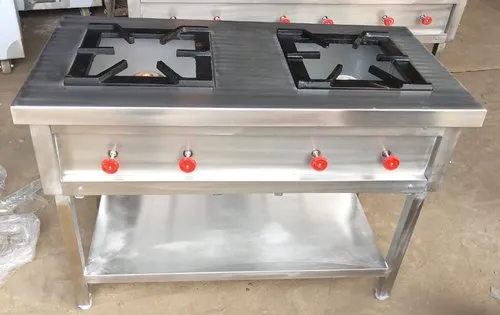
For a cloud kitchen targeting under 30 orders per day with a focused menu, a 2-burner commercial SS range is the right starting point. It occupies significantly less counter or floor space than a 4-burner unit while still providing the BTU output needed for commercial cooking.
Key things to look for:
- Cast iron burners: more durable and heat-efficient than standard burners
- SS body, mandatory for FSSAI food-contact surface compliance
- Sturdy legs with adjustable height, important for ergonomics in a tight space
When to upgrade to 4-burner: Once you consistently cross 30 orders per day, or if your menu requires simultaneous cooking of more than two items, step up to a 4-burner range. Running a 2-burner range beyond its capacity is the fastest way to slow down prep times and collect low ratings.
Counter-Top Convection Oven
In a small cloud kitchen, a countertop convection oven is one of the most versatile pieces of equipment you can own. It sits on your SS work table, handles baking, grilling, reheating, and roasting, and eliminates the need for multiple single-purpose appliances.
Ideal for:
- Bakery and snack-focused cloud kitchens
- Any cloud kitchen needing a reliable reheating station
- Menus that include grilled or roasted items
Induction Cooktop
A commercial induction cooktop is a useful supplement to your gas range in a compact kitchen, not a replacement. It works well for slow-cooking gravies, warming sauces, or maintaining temperature on pre-cooked items without tying up a gas burner.
Benefits in a small kitchen:
- No additional exhaust required directly above it if used for low-heat tasks
- Easy to store when not in use
- Energy efficient for continuous low-heat applications
Single-Tank Deep Fryer
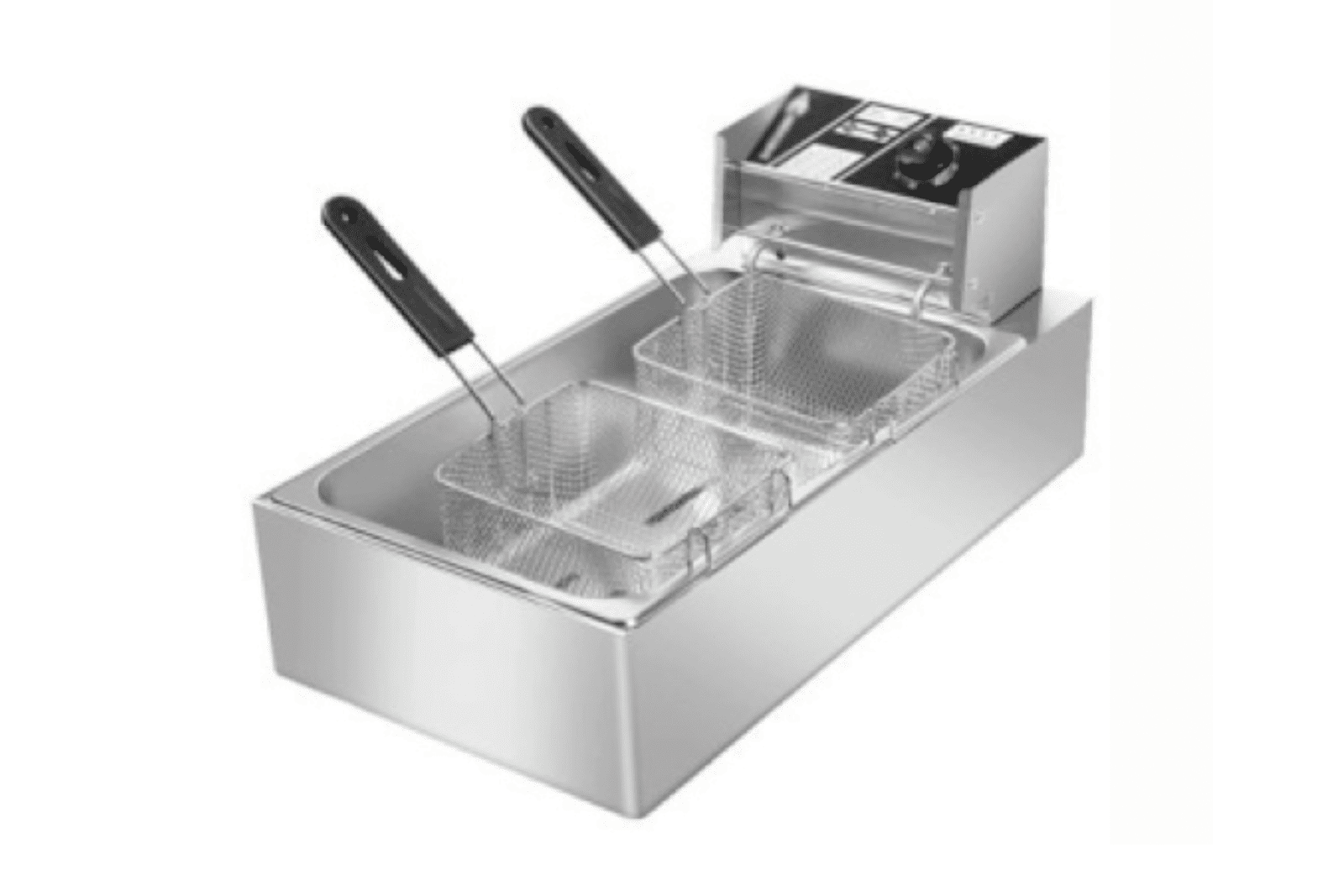
If your menu includes fried items, choose a single-tank counter-top deep fryer rather than a floor-standing double-tank unit. It handles the volume a small cloud kitchen needs without consuming valuable floor space.
4. Space-Saving Refrigeration Options
Refrigeration is non-negotiable, but in a small cloud kitchen, a full-height commercial refrigerator may consume more floor space than you can afford. Here are the right options for compact setups:
Under-Counter Refrigerator
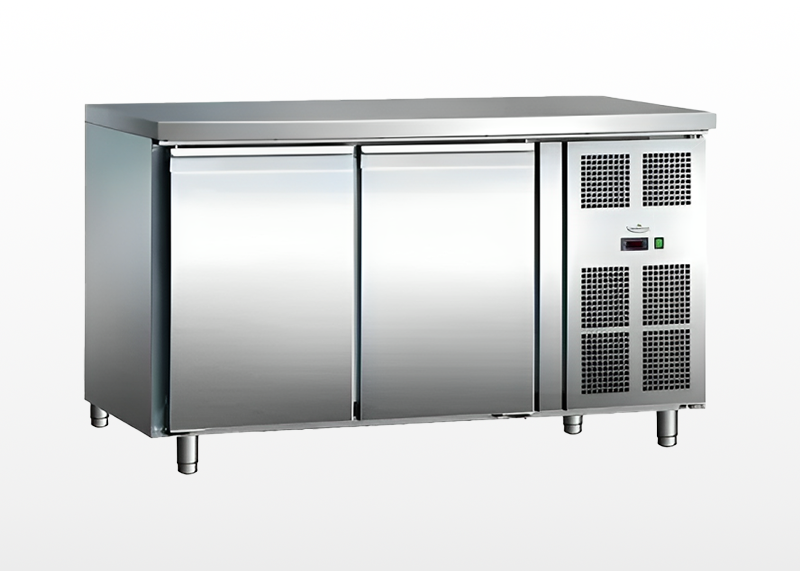
This is the single best refrigeration choice for a small cloud kitchen. It fits directly beneath your SS work table, keeps prepped ingredients within arm’s reach of the cooking station, and its flat top extends your usable workspace.
Benefits:
- Saves the floor space a full-height unit would occupy
- Doubles as additional workspace on top
- Keeps ingredients close to the cooking station, reducing movement in a compact space
Compact Single-Door Upright Refrigerator
If your menu requires more refrigeration capacity than an under-counter unit provides, a slim-profile single-door upright commercial refrigerator is the next step. Look for units that are narrower than the standard width; these fit along walls without blocking movement.
Chest Freezer
A compact chest freezer is sufficient for most small cloud kitchens storing frozen proteins or ingredients in limited quantities. If floor space is extremely tight, consider a countertop chest freezer that can be placed on a shelf or elevated platform.
What to avoid
Full-height double-door refrigerators are unnecessary for a small cloud kitchen at the start. They consume significant floor space and refrigeration capacity that a 20–40 orders-per-day operation does not need. Start with an under-counter unit and a small chest freezer – upgrade as volume grows.
5. Compact Prep and Washing Setup
Single SS Work Table with Under-Shelf
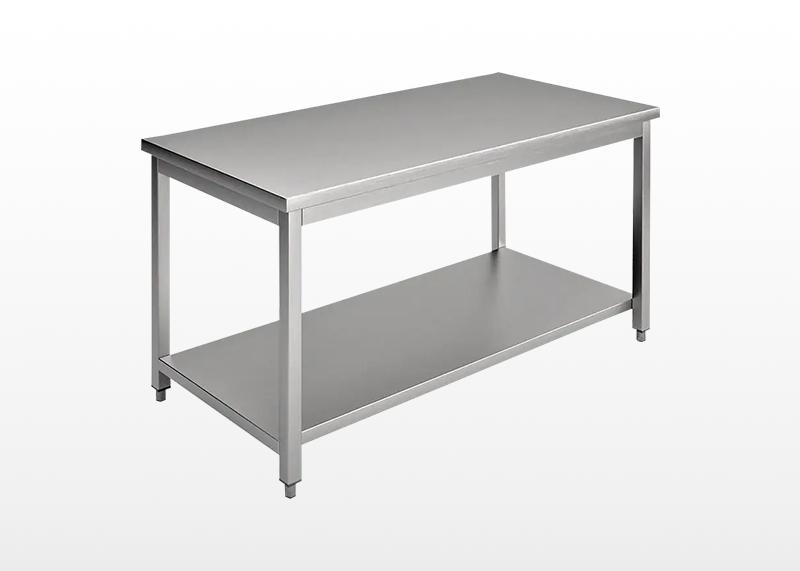
In a compact kitchen, a single SS work table with an under-shelf can serve as your prep surface, equipment stand, and storage in one unit. The under-shelf holds dry goods, equipment, or containers, keeping the main work surface clear.
Choose a table that spans the full length of one wall to maximise your prep space without taking up additional floor area.
Compact Three-Compartment Sink
The three-compartment sink is an FSSAI mandatory requirement; there is no compact alternative that will pass inspection. However, three-compartment sinks are available in varying sizes. Choose the narrowest width that still provides functional compartment sizes, typically around 36 to 48 inches total width.
Do not try to substitute with a two-compartment or single-bowl sink. This is the most common inspection failure point for small cloud kitchens.
Wall-Mounted Handwashing Sink
Rather than a floor-standing handwashing sink, choose a wall-mounted unit. It takes up zero floor space, keeps the mandatory handwash station separate from the utensil sink, and is easy to install in any position along a wall.
Soap dispenser and paper towel holder must be mounted directly alongside it; inspectors check for this.
Compact Mixer Grinder
A commercial table-top mixer-grinder handles masalas, batters, and chutneys for a small cloud kitchen without the footprint of a floor-standing commercial mixer. Choose a unit with a minimum 2-litre capacity jar for practical batch sizes.
6. Ventilation in Small Spaces
Ventilation is often the trickiest part of a compact cloud kitchen setup. You cannot skip it; an exhaust hood above every cooking station is an FSSAI requirement and a practical necessity, but in a small space it must be planned carefully.
Wall-Mounted Exhaust Hood
In a compact kitchen, a wall-mounted exhaust hood positioned directly above the cooking range is the most space-efficient option. The hood should extend at least the full width of your range, ideally slightly wider on each side.
Ducting must run directly outside, through a wall or ceilin,not into a false ceiling cavity. This is both an FSSAI requirement and a fire safety standard.
Exhaust Fan Placement
In a very small kitchen, a well-placed exhaust fan on an exterior wall can supplement the exhaust hood in maintaining air circulation. This is particularly important in Ahmedabad, where summer temperatures can make a poorly ventilated small kitchen unbearable for staff.
What compact ventilation is not
A domestic range chimney hood is not a substitute for a commercial exhaust hood. Domestic hoods are not rated for the continuous use or the volume of smoke and grease that a commercial cooking station produces. Do not use one in a cloud kitchen that will be FSSAI inspected.
7. Packaging Station in a Compact Kitchen
In a small cloud kitchen, the packaging station is easy to overlook, but a disorganised packaging area will slow your order dispatch time directly, leading to late deliveries and poor ratings on Zomato and Swiggy.
Wall-Mounted Shelf for Packaging Materials
Rather than a separate table for packaging, install a wall-mounted SS shelf near the kitchen exit for packaging materials; boxes, pouches, labels, and tape. This keeps packaging supplies accessible without consuming floor space.
Heat Sealing Machine Placement
A compact countertop heat-sealing machine can sit on the corner of your main SS work table. Position it near the kitchen exit so the packing and sealing flow moves towards the door, reducing movement for your staff.
Designated Packaging Corner
Even in a 150 square feet kitchen, designate one corner, typically near the exit, exclusively for order assembly and packaging. This separation prevents cross-contamination between raw prep and outgoing food, which is an FSSAI requirement and a practical workflow improvement.
8. Layout Tips for Small Cloud Kitchens
The right equipment means nothing if the layout forces your staff to take unnecessary steps or creates cross-contamination risks. Here are the key layout principles for a compact cloud kitchen:
Work in a straight line or L-shape The most efficient small kitchen layouts follow either a straight-line flow (prep → cook → pack → dispatch) or an L-shape where cooking and packaging are on perpendicular walls. This minimises movement and keeps raw and cooked food handling separated.
Keep raw and cooked zones separate Even in a tiny kitchen, designate one end of your work table for raw ingredient prep and the other for cooked food assembly. Use different coloured chopping boards to visually enforce this separation, which also satisfies FSSAI colour-coding requirements.
Put refrigeration at the prep end, packaging at the exit end. Ingredients flow from refrigerator to prep table to cooking station to packaging station to exit. This is the logical one-way flow that minimises cross-contamination and keeps your team from crossing paths.
Use vertical space Wall-mounted SS shelving above your work tables can double your effective storage space without using any floor area. Store dry goods, packaging materials, and small equipment on shelves; keep the floor clear.
Keep the handwashing sink at the entry. FSSAI requires the handwashing sink to be accessible at the kitchen entry point. In a small kitchen this also makes practical sense, staff wash hands when entering before touching anything.
9. Equipment to Avoid in a Small Cloud Kitchen
Some equipment is simply not suited to a small cloud kitchen, either because it takes up too much space, is unnecessary at low order volumes, or can be handled by more versatile alternatives.
| Equipment | Why to Avoid at the Start |
| Full-height double-door refrigerator | Too large for the refrigeration needs of a small operation |
| Floor-standing commercial dishwasher | Not necessary under 50 orders per day, a three-compartment sink handles it |
| 6-burner cooking range | Unnecessary footprint for under 40 orders per day |
| Floor-standing planetary mixer | Counter-top mixer grinder handles small cloud kitchen volumes |
| Tandoor (unless menu requires it) | Large footprint, heavy ventilation requirement — only add if naan or tandoori items are core menu items |
| Bain marie / food warmer | Useful at higher volumes but unnecessary in a compact kitchen at launch |
The goal is to start with the minimum equipment that handles your target volume and is FSSAI compliant, then add equipment as order volume justifies it.
10. Complete Compact Equipment List at a Glance
✅ Must-Have for a Small Cloud Kitchen
| Equipment | Space-Saving Choice |
| Commercial gas range | 2-burner SS range |
| Refrigeration | Under-counter refrigerator + small chest freezer |
| Work surface | Single SS work table with under-shelf |
| Washing | Compact three-compartment sink |
| Handwashing | Wall-mounted handwashing sink |
| Ventilation | Wall-mounted exhaust hood + exterior exhaust fan |
| Grinding | Counter-top commercial mixer grinder |
| Chopping boards | Colour-coded set (4 colours minimum) |
| Weighing scale | Compact counter-top scale |
| Dry storage | Wall-mounted SS shelving |
| Fire safety | ABC-type fire extinguisher (2 kg) |
| Packaging | Wall-mounted shelf + counter-top heat sealing machine |
| Waste management | Lidded waste bins at each station |
⏳ Add as Volume Grows
| Equipment | When to Add |
| 4-burner range | Consistently above 30 orders per day |
| Full-height upright refrigerator | When under-counter unit is at capacity |
| Counter-top convection oven | When menu requires baking or grilling |
| Single-tank deep fryer | When fried items become a significant portion of menu |
| Counter-top dishwasher | When manual washing creates a bottleneck at peak hours |
11. FAQs
Q: What is the minimum kitchen size for a cloud kitchen in India?
A functional cloud kitchen can operate in as little as 100–150 square feet with the right compact equipment layout. This is sufficient for a single-brand operation targeting up to 25–30 orders per day. Most operators find 150–250 square feet more comfortable for day-to-day operations without feeling cramped.
Q: Can a small cloud kitchen pass FSSAI inspection?
Yes, FSSAI compliance is about equipment standards and hygiene practices, not kitchen size. A 150 square feet kitchen with a three-compartment sink, separate handwashing sink, SS work surfaces, proper ventilation, and correct refrigeration will pass FSSAI inspection. A 400 square feet kitchen with domestic equipment and improper setup will not.
Q: Is a 2-burner range enough for a cloud kitchen?
For a focused menu targeting under 30 orders per day, yes. A 2-burner commercial range provides sufficient cooking capacity for this volume. Once you consistently exceed 30 orders per day or your menu requires more simultaneous cooking, upgrade to a 4-burner range.
Q: Can I use an under-counter refrigerator as my only refrigeration in a small cloud kitchen?
For very small operations with limited ingredient storage needs, an under-counter refrigerator combined with a small chest freezer can be sufficient at the start. As your order volume and ingredient variety grows, add a full-height upright refrigerator.
Q: Where can I buy compact commercial kitchen equipment in Ahmedabad?
Nilkanth Equipments, based in Ahmedabad, stocks a full range of commercial kitchen equipment including compact and space-saving options suitable for small cloud kitchens. We also carry quality pre-owned equipment for operators looking to manage their initial setup investment carefully.
Setting Up a Small Cloud Kitchen? Let’s Get It Right.
A compact cloud kitchen set up with the right equipment will outperform a poorly planned larger kitchen every time. At Nilkanth Equipments, we help cloud kitchen operators in Ahmedabad and across Gujarat choose the right equipment for their space, menu, and order volume, without over-investing at the start.