Buy Commercial & Restaurant Kitchen Equipment Online

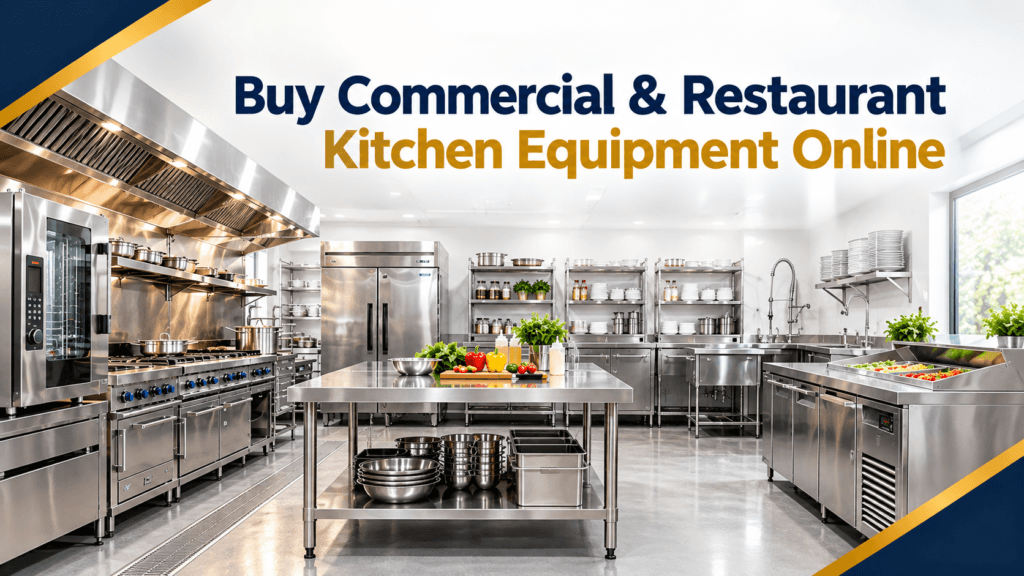
Starting or upgrading a professional food business involves much more than purchasing a few cooking machines. The right equipment affects preparation speed, food consistency, staff movement, storage capacity, hygiene, utility consumption, maintenance, and ultimately the way your kitchen operates during peak hours.
Whether you are setting up a restaurant, café, QSR, cloud kitchen, bakery, catering unit, hotel kitchen, institutional kitchen, or food stall, equipment selection should begin with how your kitchen will work, not simply with which products are available for sale.
This guide explains what to consider when Buying Commercial Kitchen Equipment Online, how to compare different categories, what specifications are often overlooked, and how to avoid expensive purchasing mistakes.
Why Choosing the Right Restaurant Kitchen Equipment Matters
A professional kitchen operates very differently from a residential kitchen.
During a busy service period, several activities can happen simultaneously:
- Ingredients are being prepared.
- Multiple cooking stations are operating.
- Orders are being assembled.
- Prepared food is being held or stored.
- Staff are moving between preparation and cooking areas.
- Dirty utensils are moving toward the washing section.
- Fresh ingredients are being taken from refrigeration.
- Finished dishes are moving toward the service or dispatch area.
If equipment is incorrectly sized or badly positioned, these activities can interfere with one another.
For example, an undersized fryer can become a bottleneck during a busy evening. A refrigerator placed too far from the preparation counter can increase unnecessary movement. A work table without sufficient preparation space can slow down food assembly.
Therefore, equipment should be selected as part of a complete kitchen workflow, rather than as individual products.
What Should You Consider Before Buying Kitchen Equipment Online?
Buying online can make product discovery easier, but professional equipment requires more evaluation than simply checking the displayed price.
Before purchasing, consider these factors.
1. Your Menu
Your menu should be the starting point.
A restaurant specialising in South Indian food will have different requirements from a pizza outlet, bakery, café, QSR, or North Indian restaurant.
For example:
| Menu Requirement | Possible Equipment |
|---|---|
| Fried snacks | Deep fryer |
| Dosa | Dosa tawa |
| Tandoor dishes | Commercial tandoor |
| Pizza | Pizza oven |
| Burgers | Griddle / griller |
| Sandwiches | Sandwich griller |
| Chinese cuisine | Chinese cooking range |
| Bakery products | Bakery oven + mixer |
| Fresh juices | Commercial juicer |
| Bulk preparation | Mixer / food processor |
| Cold storage | Refrigerator / freezer |
| Food holding | Bain Marie |
The important point is that your menu should determine your equipment list, rather than purchasing machines first and deciding how to use them later.
Different Types of Commercial Kitchen Equipment
A professional kitchen generally consists of several interconnected equipment categories.
1. Cooking Equipment
Cooking equipment forms the core of most restaurant operations.
Depending on the cuisine, this can include:
- Commercial gas ranges
- Cooking ranges
- Chinese ranges
- Dosa tawas
- Tandoors
- Fryers
- Grills
- Bain Marie units
- Induction cookers
- Pizza ovens
- Salamander grills
- Steamers
The correct equipment depends heavily on cooking technique and expected production volume.
For example, a business selling fried snacks throughout the day may benefit from dedicated frying equipment rather than relying on a multipurpose cooking range.
2. Food Preparation Equipment
Preparation is often where restaurants lose significant amounts of time.
Equipment such as:
- Mixer grinders
- Vegetable cutting machines
- Food processors
- Wet grinders
- Dough mixers
- Potato peelers
- Commercial blenders
can reduce repetitive manual work.
However, automation does not automatically mean better results. The machine should match the quantity being processed.
A small operation may not need a large industrial machine, while a high-volume kitchen can lose considerable productivity by using equipment designed for smaller quantities.
3. Refrigeration Equipment
Cold storage is one of the most important sections of a professional kitchen.
Depending on the operation, businesses may require:
- Single-door refrigerators
- Double-door refrigerators
- Reach-in refrigerators
- Under-counter refrigerators
- Display refrigerators
- Commercial freezers
- Chest freezers
- Refrigerated counters
An often-overlooked factor is access frequency.
Frequently used ingredients should ideally be stored where staff can access them without repeatedly crossing the kitchen.
Refrigeration capacity should also be considered according to:
- Daily ingredient requirement
- Peak storage requirement
- Menu size
- Delivery frequency
- Available floor space
- Required temperature zones
- Future expansion
Buying the largest refrigerator available is not necessarily the best decision. Excess capacity can occupy valuable kitchen space and increase the initial investment.
4. Stainless Steel Kitchen Furniture
Kitchen furniture is sometimes treated as secondary equipment, but it directly affects workflow.
Common requirements include:
- Stainless steel work tables
- Preparation counters
- Sink units
- Storage racks
- Wall shelves
- Trolleys
- Service counters
- Cash counters
- Custom fabrication
A preparation table, for example, can become a central workstation for cutting, portioning, assembly, plating, or packaging.
Its height, depth, under-shelf arrangement, drawer configuration, and position within the kitchen can all influence staff productivity.
5. Washing & Cleaning Equipment
A professional kitchen also needs a properly planned washing area.
Depending on the operation, this can include:
- Single bowl sinks
- Double bowl sinks
- Three-compartment sinks
- Pot sinks
- Hand-wash stations
- Drain boards
- Waste collection areas
One detail that is frequently overlooked is workflow separation.
The movement of dirty utensils should not unnecessarily interfere with food preparation. The washing section should therefore be planned with access, drainage, water supply, and staff movement in mind.
6. Storage Equipment
Storage is not simply about adding more shelves.
A good storage system should make frequently used ingredients and utensils easy to locate while keeping the kitchen organised.
Options can include:
- Stainless steel racks
- Wall-mounted shelves
- Ingredient storage areas
- Under-counter storage
- Dry-storage shelving
- Mobile storage trolleys
A useful principle is to place frequently used items within easy reach and reserve higher or less accessible areas for items that are used less often.
The Hidden Factor: Peak-Hour Capacity
One of the biggest mistakes when buying restaurant equipment is calculating capacity only from average daily sales.
Suppose a restaurant receives 120 orders in a day.
That number alone does not tell you what equipment capacity is required.
If 40 of those orders arrive within one busy hour, the kitchen needs to be capable of handling that concentrated demand.
This is why peak-hour production is often more important than average daily production.
Before purchasing equipment, ask:
How much food must this machine process during the busiest period?
This question can completely change the size and type of equipment you should purchase.
Kitchen Layout Is More Important Than Many Buyers Realise
Two kitchens can have exactly the same equipment but completely different productivity levels.
The difference can come from layout.
A professional kitchen generally needs logical zones for:
Receiving → Storage → Preparation → Cooking → Holding → Plating/Packaging → Dispatch → Washing
The exact arrangement depends on the business.
For a cloud kitchen, packaging and dispatch may be especially important.
For a restaurant, plating and service flow may receive greater attention.
For a bakery, production, proofing, baking, cooling, and storage may dominate the layout.
For catering operations, bulk preparation and transportation can influence the entire setup.
The objective is to reduce unnecessary movement while keeping related activities close together.
Measure the Kitchen Before Ordering Equipment
Before buying anything online, measure the actual installation area.
Record:
- Kitchen length
- Kitchen width
- Door width
- Ceiling height
- Wall dimensions
- Existing counters
- Gas points
- Electrical points
- Water connections
- Drainage points
- Exhaust location
- Refrigerator space
- Staff movement clearance
There is another important measurement that buyers sometimes forget: equipment opening clearance.
A refrigerator may physically fit into a space but still become difficult to use if its doors cannot open properly.
Similarly, drawers on a work table need sufficient front clearance, and service doors should not obstruct employee movement.
Electrical Requirements Should Be Checked Before Purchase
Different machines can have very different electrical requirements.
Before ordering electrically operated equipment, check:
- Voltage
- Wattage
- Phase requirement
- Current requirement
- Plug configuration
- Dedicated circuit requirements
- Installation location
A machine that fits physically may still be unsuitable if the electrical infrastructure has not been planned for it.
High-load equipment should be discussed with a qualified electrical professional before installation.
Gas Equipment Requires Similar Planning
Gas-operated equipment also needs proper planning.
Depending on the installation, consider:
- Gas source
- Gas pipeline routing
- Required pressure
- Regulator compatibility
- Shut-off accessibility
- Ventilation
- Exhaust requirements
- Equipment positioning
Gas, electrical, water, drainage, and exhaust requirements should ideally be considered before finalising the kitchen layout.
Changing these systems after installation can be considerably more expensive and disruptive.
Exhaust and Ventilation: The Part Buyers Often Ignore
Cooking equipment generates heat, vapour, smoke, grease, and odours.
Frying and grilling can produce particularly high heat and grease loads.
An effective ventilation plan should consider:
- Cooking equipment type
- Heat generation
- Kitchen dimensions
- Hood arrangement
- Grease filtration
- Ducting
- Exhaust capacity
- Fresh-air requirements
- Cleaning access
An exhaust hood should not simply be selected because it fits above the cooking range. Its design should correspond to the actual cooking load and installation environment.
This is one reason complete kitchen planning is often more effective than purchasing every item independently.
Stainless Steel: What Should You Actually Check?
Many buyers focus only on whether equipment looks like stainless steel.
There is more to evaluate.
Check:
Material
Ask what grade of stainless steel is being used and where it is being used.
Different parts of a product may have different material requirements.
Weld Quality
Look at the joints.
Poor welding can create difficult-to-clean areas and affect long-term durability.
Surface Finish
A good finish should be practical for regular cleaning and commercial use.
Edges and Corners
Sharp or poorly finished edges can create operational and cleaning problems.
Accessibility
Components requiring regular maintenance should be reasonably accessible.
Construction
Look at frame strength, legs, supports, shelves, drawers, hinges, handles, and other moving components.
The cheapest product is not necessarily the lowest-cost option over its entire operating life.
Energy Consumption Is a Long-Term Cost
Purchase price is only one part of equipment cost.
Consider the total cost of ownership:
Purchase price + installation + utilities + maintenance + downtime + replacement cost
For example, two machines may have similar purchase prices but different electricity or gas consumption.
If a machine operates several hours every day, even a relatively small difference in energy consumption can become significant over several years.
This is particularly relevant for:
- Refrigerators
- Freezers
- Fryers
- Ovens
- Grills
- Mixers
- Induction equipment
New vs Pre-Owned Kitchen Equipment
Not every business needs to purchase every item brand new.
For startups with limited capital, quality pre-owned equipment can sometimes help reduce initial investment.
However, pre-owned equipment requires additional checks.
Inspect:
- Overall condition
- Electrical components
- Heating elements
- Motors
- Compressor condition
- Refrigeration performance
- Structural integrity
- Rust or corrosion
- Previous repairs
- Availability of spare parts
- Serviceability
A lower purchase price does not automatically make a used machine a better investment.
The condition and remaining useful life matter more than the age alone.
Why Buying Equipment as a Complete Setup Can Be Better
Purchasing equipment individually from different suppliers may appear cheaper initially, but it can create coordination problems.
For example:
- Equipment dimensions may not align.
- Utility connections may be positioned incorrectly.
- Workstations may not match.
- Equipment heights may differ.
- Delivery schedules may conflict.
- Installation responsibility may become unclear.
A coordinated kitchen setup allows equipment selection, fabrication, layout, and workflow to be considered together.
This is particularly valuable for new restaurants and businesses starting from an empty space.
Common Mistakes When Buying Commercial Kitchen Equipment Online
Mistake 1: Buying Based Only on Price
The lowest price does not necessarily mean the lowest total cost.
Mistake 2: Ignoring Peak-Hour Demand
Equipment should be capable of handling your busiest operational period.
Mistake 3: Buying Before Measuring
Always confirm dimensions and installation requirements.
Mistake 4: Ignoring Utility Requirements
Electricity, gas, water, drainage, and exhaust should be planned beforehand.
Mistake 5: Purchasing Too Much Equipment
Unused equipment occupies valuable space and capital.
Mistake 6: Forgetting Maintenance
Ask about servicing, spare parts, warranty, and maintenance requirements before purchasing.
Mistake 7: Treating Every Kitchen the Same
A bakery, café, cloud kitchen, QSR, hotel, and Indian restaurant have completely different operational requirements.
A Practical Equipment-Buying Checklist
Before placing an order, ask:
Menu
- Does this equipment support my menu?
- How frequently will it be used?
Capacity
- What is the output per batch?
- Can it handle peak-hour demand?
Space
- Does it physically fit?
- Is there enough operating clearance?
Utilities
- What electrical supply is required?
- What gas, water, drainage, or exhaust connections are needed?
Construction
- What material is used?
- How are the joints and surfaces finished?
Maintenance
- Are spare parts available?
- Who provides service?
- How easy is routine cleaning?
Business
- Will the equipment remain useful if sales increase?
- Is it better to buy new or quality pre-owned?
- What is the expected total cost of ownership?
How Nilkanth Equipments Helps Businesses Plan Their Kitchens
Nilkanth Equipments provides kitchen solutions for restaurants, cafés, hotels, cloud kitchens, catering businesses, bakeries, institutional kitchens, industrial canteens, and other food-service operations.
The company supplies cooking equipment, refrigeration solutions, preparation equipment, stainless steel furniture, storage systems, sinks, utensils, crockery, and related kitchen products. It also works with new, pre-owned, and customised kitchen requirements.
Rather than treating every customer requirement as identical, kitchen planning should consider the menu, expected order volume, available space, workflow, utilities, and future expansion. Nilkanth’s existing kitchen-planning guidance follows this approach.
For cloud kitchens in particular, Nilkanth discusses compact layouts, preparation stations, refrigeration, cooking equipment, storage, and packaging workflow as interconnected parts of the setup.
Final Thoughts
Buying commercial kitchen equipment online should not be treated as simply adding products to a shopping list.
The better approach is to first understand your:
Menu → Production Volume → Workflow → Space → Utilities → Equipment → Maintenance → Future Growth
When these factors are considered together, your kitchen becomes easier to operate and easier to expand.
Whether you are opening a small café, launching a cloud kitchen, establishing a restaurant, expanding a catering operation, or developing a large institutional kitchen, the objective should be the same:
Build a kitchen where every piece of equipment has a purpose.
Nilkanth Equipments helps businesses plan and source professional kitchen solutions according to their operational requirements, from individual equipment requirements to more complete kitchen setups across Ahmedabad and Gujarat.
Frequently Asked Questions
What should I buy first when setting up a restaurant kitchen?
Start with the menu and production requirements. Identify the cooking, preparation, refrigeration, storage, washing, and service equipment required for your core dishes before finalising the purchase list.
How do I choose the correct equipment capacity?
Consider both average daily production and peak-hour demand. The equipment should be capable of supporting your busiest operating period without creating a bottleneck.
Is stainless steel important for a commercial kitchen?
Stainless steel is widely used in professional kitchens because it can provide durability, cleanability, and resistance to corrosion when the appropriate material and construction are selected.
Should I buy new or pre-owned equipment?
It depends on your budget, equipment type, expected usage, condition, serviceability, and availability of spare parts. Quality pre-owned equipment can be useful for some startups, but it should be inspected carefully before purchase.
Can kitchen equipment be customised?
Yes. Certain preparation tables, counters, sink units, storage systems, exhaust components, and other fabricated items can be designed around the available kitchen space and workflow.
Where can I buy commercial kitchen equipment in Ahmedabad?
Nilkanth Equipments is based in Ahmedabad and supplies kitchen equipment and related solutions for restaurants, cafés, cloud kitchens, hotels, catering businesses, bakeries, institutions, and other food-service operations.
What is more important: equipment price or equipment suitability?
Suitability. An inexpensive machine that cannot handle your workload can become expensive through downtime, replacement, labour inefficiency, and lost service capacity. The better decision is to evaluate performance, capacity, construction, utilities, maintenance, and total cost of ownership together.